
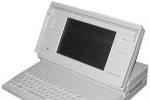
I think PCWorld is totally unfair to the Apple Macintosh Portable. Think way back to 1989 – any portable computing devices under 20lb kicks ass, and will most likely cost an arm and a leg – right? Back then, I know guys who would more than gladly give up their left nut for this thing. 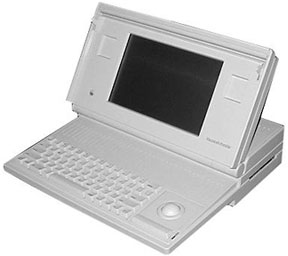
Some buildings are portable, if you have access to a Freightliner. Stonehenge is a portable sun dial, if you have enough people on hand to get things rolling. And in 1989, Apple offered a “portable” Macintosh–a 4-inch-thick, 16-pound beast that severely strained the definition of “laptop”–and the aching backs of its porters.
Huge lead-acid batteries contributed to its weight and bulk; the batteries were especially important because Portable wouldn’t run on AC power. Some computers are affordable, too; the Portable met that description only if you had $6500 of extra cash on hand.
Details
- introduced 1989.09.20 at $6,500 ($7,300 with hard drive); replaced by backlit model 1991.02
- requires System 6.0.4 to 7.5.5 (see caution on wake up crashed caused by newer drivers)
- CPU: 16 MHz 68HC000
- performance: 2.0 (relative to SE); 2.15, Speedometer 3; 1.3 MIPS
see Benchmarks: Portable for more details - ROM: 256 KB
- RAM: 1 MB, expandable to 9 MB using a special 30ns SRAM card (only one slot)
- display: 9.8″ 1-bit 640 x 400 pixel
- 40 MB 3.5″ hard drive standard
- ADB port for keyboard and mouse
- DIN-8 serial ports on back of computer
- DB-25 SCSI connector on back of computer
- batteries: 9V “transistor” battery for PRAM, 6V 5Ah sealed lead-acid for power (over 2 lb.)
- proprietary modem slot
- Gestalt ID: 10
- Size (HxWxD): 4.05″ x 15.25″ x 14.83″
- weight: 15.8 lb.
- power supply: 5W, 13 amps
- model number: M5120
The 25 Worst Tech Products of All Time [PC World]


I read the PC World piece when it came out, and also thought way too harsh. Of course, I bought not one, but because I liked it so much, another for my wife on an around the world research trip. It was heavy if you were not in good shape, but ideal for fieldwork once you got it on site. Ran 6-8 hours on a charge, worked well outside in bright sunlight, and was fast for the time.
While I certainly like my MacBook Pro 17 a lot better, the portable was a lifesaver at the time.
I gotta admit that one of the amazingly cool things about the Macintosh Portable was it’s battery life. Yes, lead-acid will do that (that’s why they’re used in cars), but you could get 12 hours of battery life out of the thing.
Actually, though, my favorite story is the woman I know who bought a Macintosh Portable instead of a PowerBook. She lived in New York City and liked the weight of the device. Someone could push her down, grab to the PowerBook, and run off. No one was going to run very fast carrying a Macintosh Portable… :^)
leave it to apple to be innovative…other than car batteries and the mac portable, where else is lead acid being used in this manner?
Lead acid was standard fare for the time. Remember, this was 1989. This thing absolutely wiped the floor with it’s contemporary Toshiba competitors running DOS.
Isn’t this like dissing model-T Fords for not having air conditioning, anti-lock brakes, air bags, and satellite radio?
The Mac Portable did a great job for me on an environmental science exchange project in Egypt in 1991. Great battery life, as I had enough RAM to run a primary application and its data on a RAM disk. I had a model with a backlit screen, but the screen was very easy to read in bright sunlight.
Yes, it was heavy, but tough and very well constructed. I later bought a PowerBook 170 that was also used in an Egyptian science exchange project and donated the Mac Portable to a researcher at Alexandria University in Egypt — where it was still running well several years later.
Lead acid wasn’t standard at the time. Back then, all other laptops were designed around NiCad batteries.
A GUI wasn’t standard either. All other laptops were designed around DOS.
PC World thought the Macintosh used a toy operating system. Real computers used DOS. A couple years later, the magazine jumped on the Windows bandwagon. The Mac OS was crap, and Windows 3.0 was sliced bread. PC World was batting 1.000!