
Apple has been busy with some paperwork recently. Potentially pointing toward new features, a couple of patent applications were recently filed.
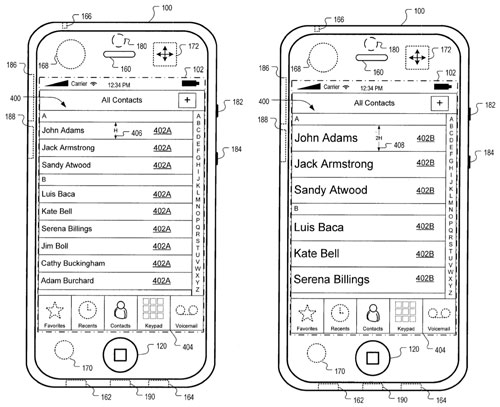
According to the patent filing:
There is a need for providing a user interface in a personal media device that minimizes either or both a user’s physical and visual interactions with the personal media device, especially while the user is performing other activities that require, for example, the user’s visual senses.
The first application published a couple of weeks ago actually explores the possibility of using motion as an interface method:
One problem with existing portable media devices such as cellular telephones is that users can become distracted from other activities while interfacing with the media device’s video display, graphical user interface (GUI), and/or keypad. For example, a runner may carry a personal media device to listen to music or to send/receive cellular telephone calls while running. In a typical personal media device, the runner must look at the device’s display to interact with a media application in order to select a song for playing. Also, the user likely must depress the screen or one or more keys on its keypad to perform the song selection. These interactions with the personal media device can divert the user’s attention from her surroundings which could be dangerous, force the user to interrupt her other activities, or cause the user to interfere with the activities of others within her surroundings.
Already, the iPhone has an accelerometer allowing users to shuffle songs by shaking it. Also, motion-detecting technology has also been widely used by application developers who have incorporated the functionality into games and other kinds of apps. But Apple appears to be moving a few steps further in making motion an even bigger part of interacting with the iPhone.
The patent filings seem to suggest that Apple is looking into the interaction users have with phones while busy doing something else (like running). As using accelerometer features can be dangerous due to distraction, new gesturing technology would try to solve this issue. For example, when a user is running, the device might provide an alternative movement-based interface for adjusting the music volume or answering a call. This level of feature is very advanced and may be a little while away just yet. But exciting none the less.
[via CNET]


I am still unaware of the iPhone using the shuffle feature when shaking the device. I think any upgrades to the interface is good for a device that is really good, but can get better.