
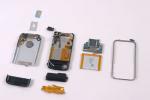
If there’s one thing we can learn from the past few days, it’s that value is definitely subjective. Some people – usually the ones trying to make their way through crowded sidewalks outside Apple stores – balk at the $500-600 pricetag of the iPhone, while for others it’s a pittance for the convergence of cellphone, full internet portal and iPod. But while value might be subject to the disposition of the wallet-holder, cost is quite another thing; analysts Portelligent have stripped the iPhone down to its bare circuitry and decided that it costs just $200 to build.

To be precise, that’s $200 for the 4GB version and $220 for the 8GB iPhone; they’re figures based on a little guesswork and sleuthing, since Apple is notoriously tight-lipped about who provides hardware and components, even to the point of obscuring the manufacturer of the clever multi-touch screen.
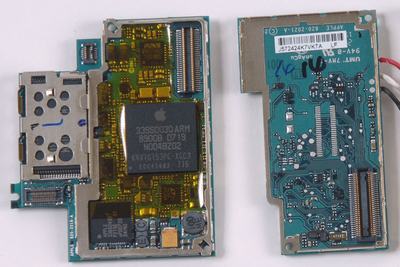
“This screen is like nothing I’ve ever seen before” Portelligent CEO David Carey admitted, before suggesting that it’s the product of German specialists Balda and slapping a $60 cost on it. Similarly covert are the main CPU chip and the flash memory; they bear the Apple logo but have serial numbers tellingly-close to components in Samsung’s range.
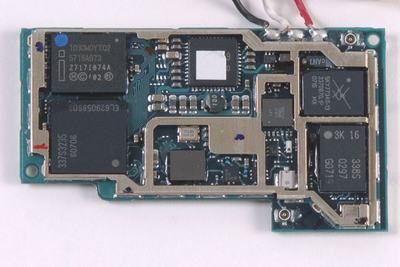
Licensing fees for the ARM processor technology are also important to consider; the Samsung CPU uses ARM Holdings’ patented core and allows Apple to build functionality around it. An NXP Semiconductor chip found elsewhere in the phone is also believed to be ARM-based. In fact Portelligent are impressed by the electronic origami and economical thinking that Apple have had to put into the iPhone:
“A great deal went into the internal mechanics and how it all came together, there are lots of tiny nooks and crannies where things have to be very precisely tucked in to make it all fit together” David Carey
In that way, ostensibly straightforward features and functionality – such as the last-minute extended battery life – come thanks to a multitude of sources. Battery is accounted for by a trio of Philips, Texas Instruments and Linear Technology chips that manage power supply, while connectivity is down to products by Infineon, Skyworks, RF Micro Devices, Marvell Technology Group and Cambridge Silicon Radio. Some of the headline grabbing features, such as the auto-rotation, demand the inclusion of parts never before featured in cellphones, all of which must be squeezed in the slender casing.
Still, despite all that complexity Portelligent stand by their hardware cost estimates. Those figures may not include development or manufacturing fees – in fact the current iPhone manufacturer is unknown, with previously-tipped Chinese company Foxconn denying any involvement – but nonetheless it’s a healthy gross margin of more than fifty percent. With iPhone sales tipped at over 500,000 this launch weekend alone, it’ll be interesting to see where the handset sits in the list of “most profitable products” for the company, a list recently dominated by the iPod.
[via Business Week]


In the first picture, the chip with the letter “I” on it is an Intel 32 megabit flash memory used to handle the protocols for making call.
Dunno if that helps you guys figure out how the iPhone works :)
Iphone Software also require dollars and cents to built up. Hardware without brillant software is useless.
Hi; Excellent post for me. Your post has good quality. I wish to has good posts like yours in my blog. How do you find these posts? And you have a problem about your template.You should fix your problem about your template … I recently came across your blog and have been visitingalong. I think I would leave my first comment. I don’t know what to say except that I have enjoyed reading. Nice blog. I will keep visiting this blog very often.Good day…